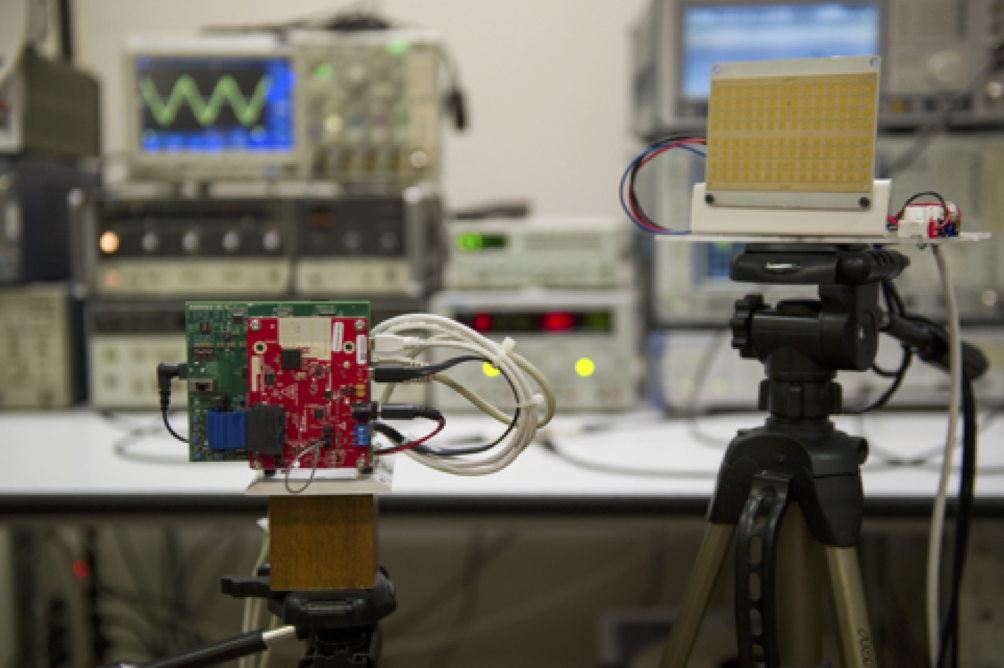
The deployment of new applications that can expand the mobile systems market is closely related to the availability of very high transmission capacity, and of radio frequencies at present not crowded, at frequencies 60 GHz and beyond. In this context in the ICT Lab several studies were developed for mm-Wave channel measurements, at 76 GHz, in order to derive a propagation model to be applied in different environmental conditions. Automotive radars working in the 77-81 GHz range are also considered, since they are able to guarantee high performances at the expenses of a relatively low cost, and their application may be extended to several fields in addition to the original one. As an example, this kind of radars is used to discriminate different types of people’s movements in a real context, exploiting spectrogram and range-Doppler maps obtained from the radar. Through the application of principal component analysis (PCA) and t-distributed stochastic neighbor embedding (t-SNE) algorithm for dimensionality reduction, and the use of machine learning techniques, people’s ways of walking are classified with a very good precision. With proper processing of the radar signal useful information about physiological parameters of subjects are also derived.